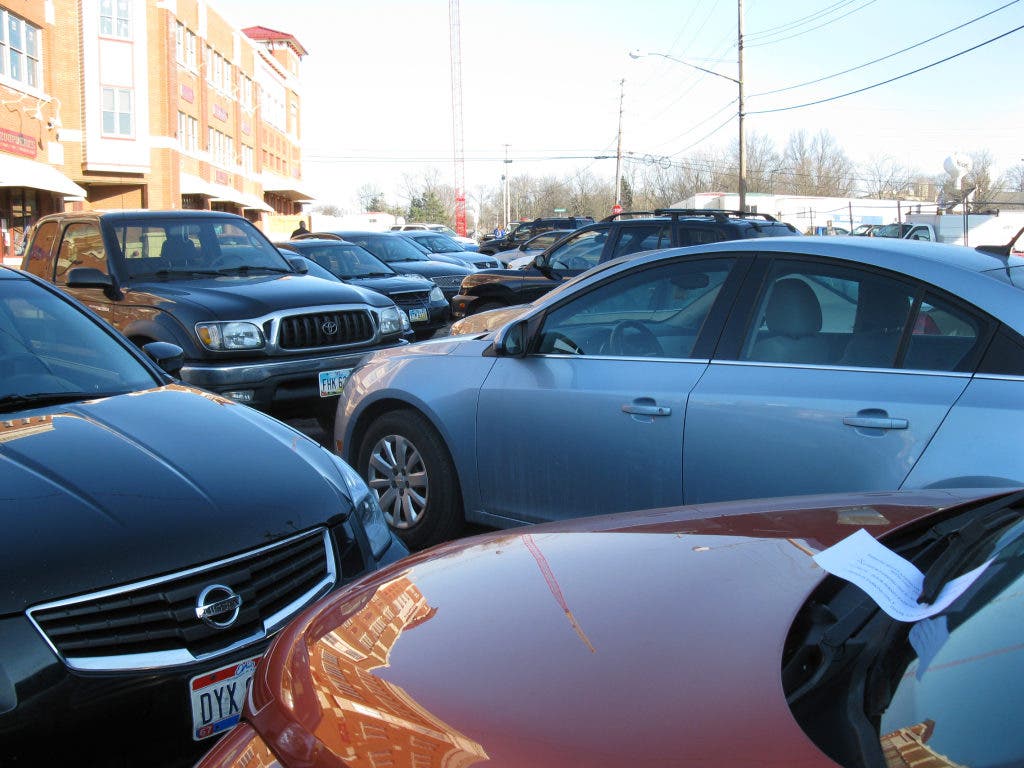
I am pleased to see that Kent City Council has adopted the recommendations of the Parking Action Committee to implement a downtown Parking Management System. This system – which will allow parking to be priced based on market demand – will result in convenient parking being available for short-term visitors to downtown offices, restaurants and retail establishments.
Yes, we in Kent are accustomed to having “free public parking” but, in reality, it never has been. Indeed, the 500 public parking spaces in the downtown area have been heavily subsidized by the public. As Donald Shoup, one of America's leading experts on parking has put it, “Who pays for free parking in America? Everyone but the motorist.”
So why do I want those of us who drive to pay for the privilege of parking in our downtown? There are many reasons, the most important of which is that we want to take up as little of our public and private space as possible with parking.
We want our most valuable real estate to be used for productive spaces, public and private, where people meet and do business. We also want as much space as we can get set aside for trees, landscaping and streetscape amenities to make our downtown enjoyable and a desirable destination for citizens and visitors alike.
A second reason why we want the motorist to pay for parking is because we, the public, have made and will continue to make costly improvements to and maintenance of the downtown streets and parking, and this parking needs to be used as efficiently as possible.
Spaces need to turn over many times a day in order for retail and restaurant businesses to thrive, and long-term parkers need to be encouraged by market pricing to seek less costly parking or, even better, to access our downtown by transit, by foot or by bike.
By pricing parking appropriately someone who comes downtown to spend $2 on coffee will think twice about renting a parking space that someone shopping or coming for a nice meal is willing to pay more for.
A third reason why parkers should pay is that parking is a public utility that we use to different levels. Just as we pay for water based on how much we use, right-pricing of parking has been shown to result in a more efficient utilization of the parking resource.
As it is now, we all pay for parking that many of us seldom use, and this cost is hidden in the city budget in a variety of line items. While the intention is to price the parking to cover the basic management costs, over time the city should consider making the parking users pay for the entire system of parking, and indeed more of the burden for the maintenance of the downtown.
A fourth reason that we need to pay for parking – which I did not hear discussed as a basis for implementation – is that it begins to send us more market signals as to the real costs of our current transportation system.
As it is now, parking policy in urban and suburban areas alike encourages automobile use over more ecologically frugal modes of transportation. Donald Shoup estimated in 2002 that the economic cost of this subsidy was at least $129 billion per year.
Our climate crisis would suggest that increasing the cost of public parking, as well as taxing private parking, might be a concrete way of connecting our transportation choices to climate change and be a better way of paying for sustainable transportation modes than begging for crumbs from a diminishing supply of taxes on gasoline.
Perhaps the most important reason to embrace a pay-to-park regime for our city is the growing interest by the younger generation in living in thriving, convivial and hip places, where bicycling and pedestrianism are given precedence over automobiles.
Making more room for bike racks, lockers and outdoor cafes, as well as making state-of-the-art pedestrian and bicycle facilities like the University Esplanade and Portage Hike & Bike Trail, will make our town a safer and saner place for all of us.
Change can be hard, but this change shouldn’t be. In a day when the price of filling up a tank of gas can change $10 or more a day, the cost of parking is literally pocket change – or a swipe of the debit card – whichever is easier.
If business owners and their employees saw fit to park somewhere other than in front of their establishments, there would be more available spaces, at least on Water Street where I do most of my downtown business.
Should every place that takes a debit card be considered elitist? I'd like to think not or we're going to leap backward in time (which many people want, *sigh*). I personally enjoy the ease of using my debit at the gas pump. I never thought it was elitist. After watching the comments on Kent Patch for long enough, Chris, I think you just don't like Rick and no matter what the man says, no matter how relevant or vaild his points and opinions, you're going to balk at them.
As Mr. Hawksley noted in his article: most trips into the downtown area are for very short visits.... less than a half hour and averaging 15 minutes.... pay to park? no. As Mr. Hawksley said: WE ARE ALREADY PAYING FOR PARKING WHICH MAKES ME WONDER ... WHY ARE WE GOING TO BE CHARGED AGAIN?
It could simply be that he doesn't agree with Mr. Hawksley's points. I fit into that. I rarely ever agree with what Mr. Hawksley writes (true here as well). It has nothing to do with my personal opinion of him (I don't know him personally and I doubt Mr. Myers does either). Most downtown merchants deal with non-essential items, so they very much depend on "impulse" shoppers and people coming just to browse. They can't depend on people who come there for things they actually *need* on a regular basis. When people have to worry about a meter, they will spend even less time doing that (if they come at all). That's why shopping centers and "big box" stores have ample parking available; they WANT people to come and stay for awhile. The most successful businesses adjust to trends and preferences of customers; they don't try to go against them and "hope for the best". The notion that "everyone pays except the motorist" is not true since a lot of the motorists are residents of Kent and/or work in Kent (i.e. taxpayers). The only way the city could rationalize having meter parking is if they cut all funding for parking from the general budget and make it self-sufficient so that taxpayers aren't paying for it already (similar to how the Ohio Turnpike operates). That's not likely to happen.
This isn't about big-box vs. downtown shops, who aren't in competition in the first place. It's about livability, and the maintenance of a level of service and convenience for the greatest number, and earning the revenue to pay for this from the folks who use the services. Don't want to pay to park? Fine, there are lots of places you can go, and you'll free up spaces for those of us who want them and are willing to shell out a few cents for them.
These questions need to be answered fully prior to any contract being let for the purchase and installation of them. b seems to have no problem with business owners and employees taking up spaces that shoppers need. I would think that more revenue comes into the city via income taxes paid by the owners and employees than the meters will NET unless exhorbitant charges are made for parking. Am I wrong? Has anyone looked into this? The fewer shoppers, the less money made by the businesses, the less successful the downtown is, and the fewer the income tax dollars. Of course, the city has allowed all the new development without allowing adequate space for parking. Owners and employees who take up street spaces are doing a disservice not only to their business but to every other business in town. Perhaps they can park in the multi-modal parking deck. Has anyone yet decided what the charge there will be? Ms. Creese, I wouldn't know Mr. Hawksley if I ran into him. I will balk at anything anyone says if I believe it is wrong. I just hope council doesn't jump into something that has not been adequately considered. I have here provided some thoughts for consideration. Blast away at me if you want, but think!
argument is moot. business owners and employees need places to park as well as all others. it's not an either/or equation.
Unless I'm mistaken (I haven't been out that way in some time), even Hudson's "First and Main" shopping district doesn't even charge patrons to park. Is Kent really going to insist on paid parking when a neighborhood with a much higher income bracket doesn't?
I agree that not everyone can currently bike safely or ride transit conveniently. Part of the reason for this, as stated in my piece, is the subsidy of the automobile, such as free parking, that has encouraged inefficient and resource wasting development patterns. First and Main is highly subsidized by the city of Hudson, and last I checked more than $1 million a year comes from its general fund to prop up the downtown TIF that is not making ends meet.